Category: Blog Post

  • Mindfulness in Nature

    Mindfulness:

    1. A mental state achieved by focusing one’s awareness on the present moment, while calmly acknowledging and accepting one’s feelings, thoughts and bodily sensations, used as a therapeutic technique. 
    2. The quality or state of being conscious or aware of something.

    When I decided to move to Yellowstone to work for 6 months, I had the idea that I would “change everything about her using colors bold and bright”.  I was going to be vegan, drink herbal tea, meditate, hike every single day, lose a ton of weight, and make this big change to become someone completely different inside and out.  Well, the best laid plans…. The biggest change on the outside is that I haven’t worn make up or done anything to my hair in 6 months.  There is something very liberating about being completely natural in my appearance.  And, not one person has said, “Oh do you not feel well?” or “You look really tired.” They don’t know me any other way here. I feel like more my authentic self. And, goodness, has it decreased the time it takes to get ready for work in the morning!

    A friend of mine said something to me just before I left Texas.  She advised me not to seek out some big, monumental change.  She suggested, instead, that I just take what life brings, live in the moment and ENJOY!  She was worried I was putting too much pressure on myself, and that I would end up being disappointed.  She is one of the smartest people I know, and I took what she said to heart. 

    What I have tried to do is be mindful of everything around me.  I’ve tried to quiet my mind and absorb all that life in Yellowstone has to offer.  It’s something new and different and magical every day.  I wanted to be open and welcoming of all things.

    I was born and raised in Texas.  I have always said if I had the opportunity to move to another part of the country, I would do it in a second.  And I did.  It would have been perfect if only my wife and pup were here too.  There are a lot of things to like about Texas, but there are many things I do not like.  The climate (both political and otherwise) does not appeal to me at all.   

    When I was a little girl, I spent hours daydreaming about what it must be like to have actual seasons.  I longed for a New England autumn, winter in the Rocky Mountains, springtime in the hill country of Texas and summers in San Diego.  I thought about how great it would be to wake up to snow on Christmas morning.  I mean, Santa needs snow to land his sleigh!

    In Texas, we have two seasons – Hot and Not Quite So Hot.  Sometimes it’s hard to even tell what month it is once you get to April.  It’s impossible to know when Autumn starts if you go by weather alone.  WE dictate what season it is by how we decorate our homes, what is cooking on the stovetop, and what we are watching on the television.  The only way you know it’s September, or October, or November is by the abundance of pumpkin spice everything everywhere.  There is not usually frost on the pumpkin at Halloween. In fact, we are lucky our pumpkins haven’t decomposed due to the heat.  Christmas?  It could be 80 degrees (probably) or it could be 40 degrees (possibly).  Texas weather is bipolar.  I believe I get seasonal affective disorder, because there are no seasons. 

    I have experienced all four seasons living in Montana for 6 months.  When I arrived, it was late winter/early spring.  There was still snow on the ground, and we had a couple of snowstorms before spring came for good.  Spring was amazing with wildflowers and newborn baby animals all around.   In Gardiner, a town of only about 700 people, the excitement was palpable.  People were so ready to say goodbye to snow and cold.  The town was bustling with energy.  Summer came and with it – tourists.  A great boon to the economy, but a strain on folks as the season wears on.  By August, you could feel a weariness coming over the town.  A few months of increasing the population by hundreds of people every day was taking its toll.  By September, people were starting to prepare for the upcoming winter.  The ranchers were storing hay for the winter. Snow poles were going up on the roadsides. Folks were scrambling to get all the fruit off their trees to keep the bears away.  Flowers and plants were replaced by firewood at the local market.  There was a sense of urgency to that month.  And by October, it was all over.  The whole town seemed to slow down.  It seemed as if they were steeling themselves for the next 6 months of winter.  As I write this, there are multiple road closures throughout the park due to winter weather driving conditions. My drive to work this morning was treacherous. Snow covered roads, sideways snow falling at a good clip, and snowplows out to protect us all. Winter is here. Already. It has been an interesting observation, and I am enjoying watching the rhythm of it all.  

    My time here is rapidly coming to an end.  I have had a marvelous experience, AND I am ready to be home with my family and friends.  I’m a ball of mixed emotions right now.  I am also trying to live in the moment about that. What I hope to continue is the state of mindfulness I have been living here. I want to be able to really enjoy the things that are around me when I get back to Texas.  Perhaps, I will be able to see it with fresh eyes.  I will seek out opportunities to be in nature at home more.  We have an amazing back yard with beautiful sunsets, birds, a creek that flows behind our home, and a puppy willing to keep me company on his very own lounger.  I miss that and will appreciate it much more than I did before.  They say you don’t know what you have until it’s gone.

    I have a couple of bands who are my go-to when I need a pick me up. Dave Matthews has a lyric in one of his songs, “It’s not where you are, but who you’re with that really matters.” That lyric rings so true now. I’ve learned I can be in my favorite place, but if my favorite people aren’t here with me, somehow it feels less.

    When I return home, I’m going to try to not let all the hustle and bustle overtake my sense of peace, tranquility, and positivity. If it does – that’s on me. 

    “Makes much more sense to live in the present tense.”

    Eddie Vedder

    “In nature, nothing is perfect, and everything is perfect.  Trees can be contorted, bent in weird ways, and they’re still beautiful.”

                                                                                                     Alice Walker

    “Look deep into nature, and then you will understand everything better.”

                                                                                                 Albert Einstein

    “Heaven is under our feet as well as over our heads.”

                                                                                       Henry David Thoreau
  • Geysers and Hot Springs and Mud Pots, OH MY!!!!

    THERMAL BASIN FACTS

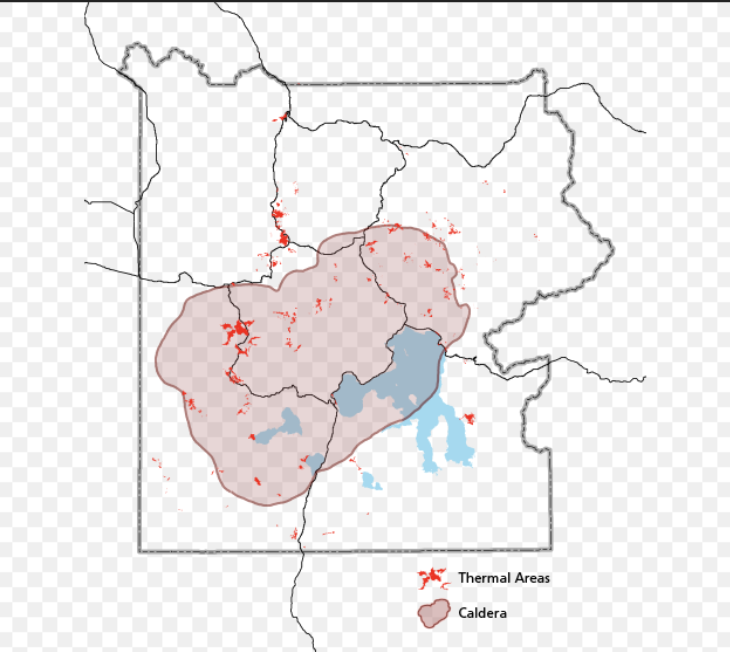
    • The Yellowstone Caldera was formed about 640,000 years ago following a super eruption.  The ground collapsed into the emptied magma chamber, creating the caldera which is about 30 miles wide.  The eruption was 1000 times larger than Mount St. Helens.
    • Yellowstone is home to the highest concentration of thermal features on the planet. 
    • There are >10,000 thermal features in the Park.
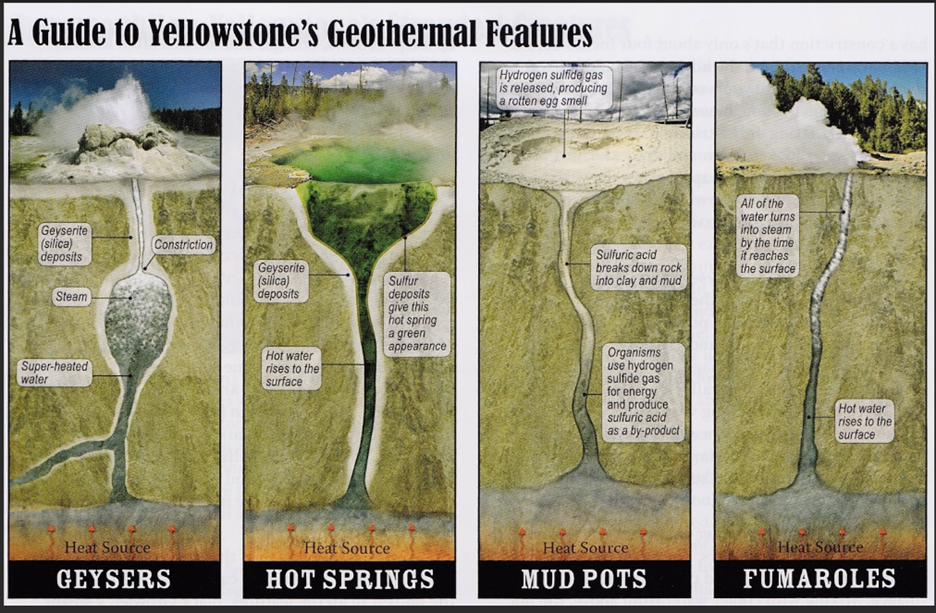
    • More than ½ of all geysers in the world are in Yellowstone.  Mostly due to the unique concentration of rhyolitic lava which has a high concentration of silica necessary for the pressure of a geyser.
    • Types of thermal features include:
      • Hot springs – most common thermal feature
      • Geysers
        • Two types of geysers:
          • Fountain geysers that erupt through surface water
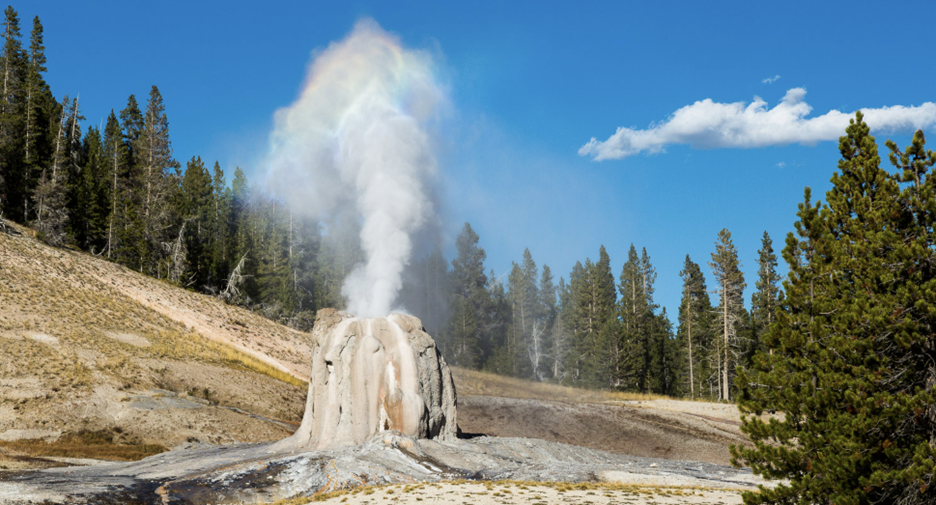
          • Cone geysers that shoot out a jet from earth and create a cone over time
      • Mud Pots
      • Fumaroles (steam vents)
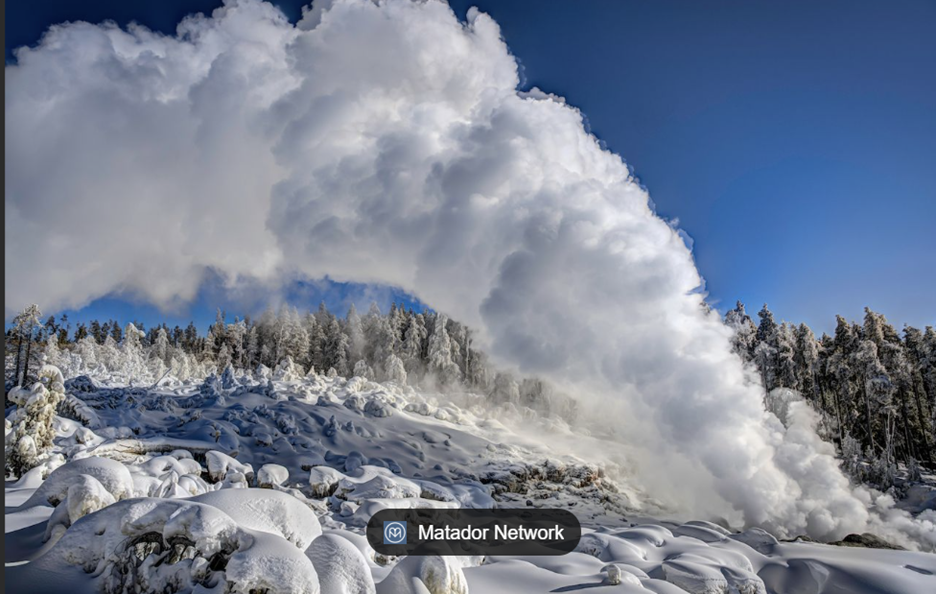
    • The tallest geyser on earth is Steamboat Geyser found in the Norris Geyser Basin.  Recent evidence shows it may be entering a phase of dormancy.  When it erupts, it can shoot water as high as 300 feet in the air.
    • Old Faithful is predictable largely due to its isolation from other features.  It shoots water and steam 150-180 feet in the air. A geyser erupting in a valley with Old Faithful in the background

AI-generated content may be incorrect.
    • While known for its predictability, it is not the tallest even in the Upper Geyser Basin.  Just across the river, Beehive Geyser reaches heights up to 200 feet.
    • Grand Geyser is the largest predictable geyser erupting every 8 hours and can reach 200 feet per eruption.
    • While Old Faithful is regular, it is not the MOST regular in the park. That would be Bead Geyser of the Pink Cone group along Firehole Lake Drive in the Lower Geyser Basin.  It erupts every half hour.
    • Certain cones geysers are likely near or over 10,000 years old – like Castle, Lone Star, and White Cone
    • Difference between hot springs and geysers:
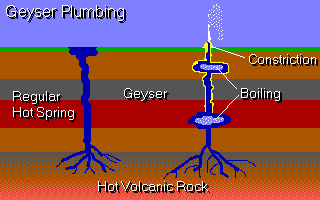
      • Geysers have constrictions underground that trap water and heat it until it erupts
      • Hot Springs do not have any constrictions
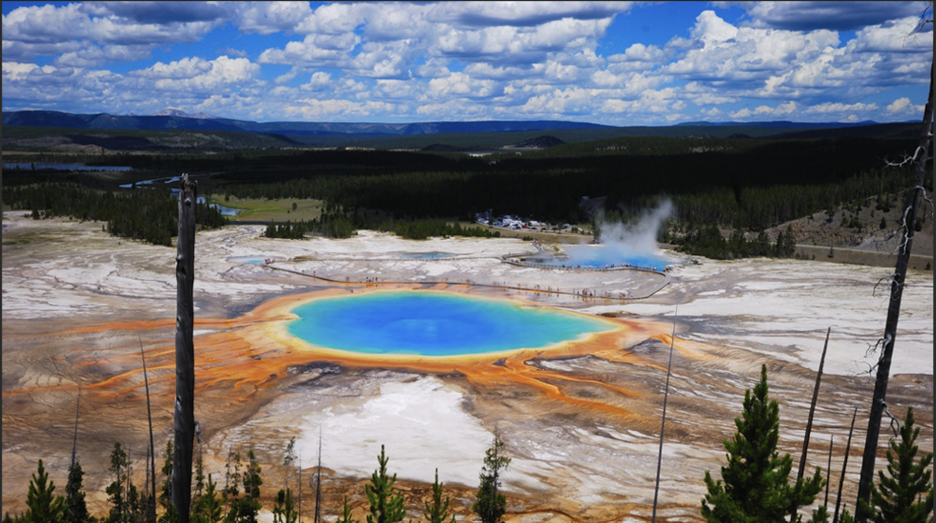
    • The largest hot spring in Yellowstone is Grand Prismatic Spring. It is the third largest in the world.
    • Most people assume all thermal features are acidic.  This is not true.  Norris Geyser basin is extremely acidic and has a pH as low as 1.4 in some areas.  Norris also has one of the few acidic geysers – Echinus Geyser.
    • Most geysers are typically alkaline. 
    • Many of the older thermal features have endemic life found only in that one feature and nowhere else on earth
    • Rovers on Mars are using information from Yellowstone (like the Terraces in Mammoth partly created by life) to help look for signs of life on that planet
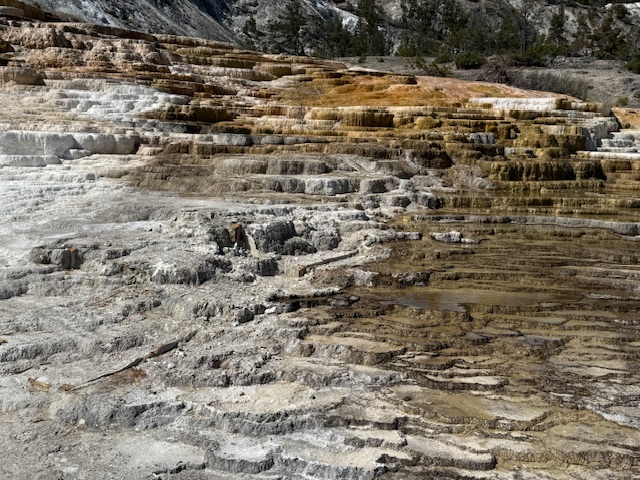
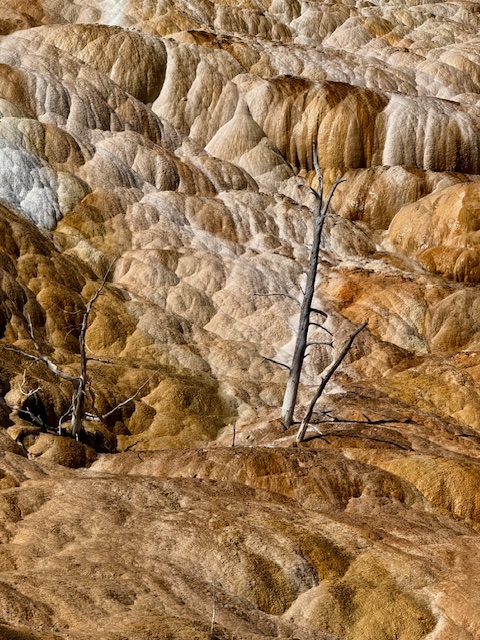
    • Most features are silica based but ones in the Mammoth area are calcium carbonate base from limestone of ancient seabeds. When the mineral rich water reaches the surface, the calcium carbonate precipitates as travertine forming the terraces and giving them the unique look.
    • Many of the features’ water has been underground for hundreds of years.  Though some, like those at Mammoth, have been underground for more than 10, 000 years.
    • The colors of hot springs are typically temperature related rather than mineral related.  Bright blue and clear are the hottest – usually over 170 degrees.  Other colors are yellow, green, red, and ochre.  Some, like Blood Geyser, get their color from minerals like iron.
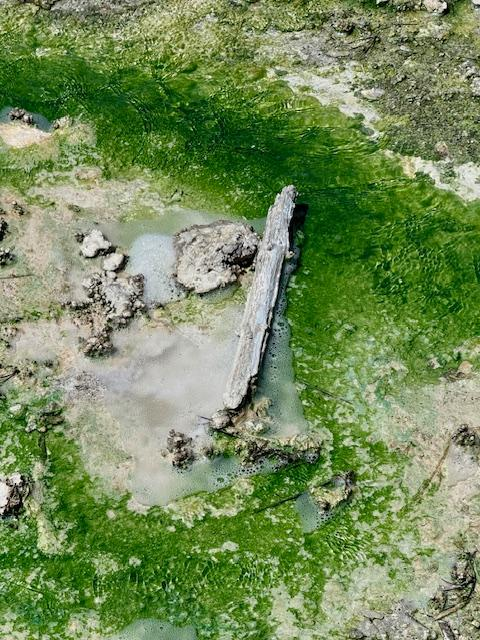
    • Microbes that thrive in thermal features are called thermophiles.  Heat loving organisms.  They are individually microscopic – but trillions of them in a single area create visible and colorful mats
    • Fumaroles are vents for gases like steam, carbon dioxide and hydrogen sulfide.  They are heated by magma chambers below the surface, which heat groundwater that then escapes as steam or gases.  The groundwater source is limited thus only producing steam and not a geyser or hot spring.
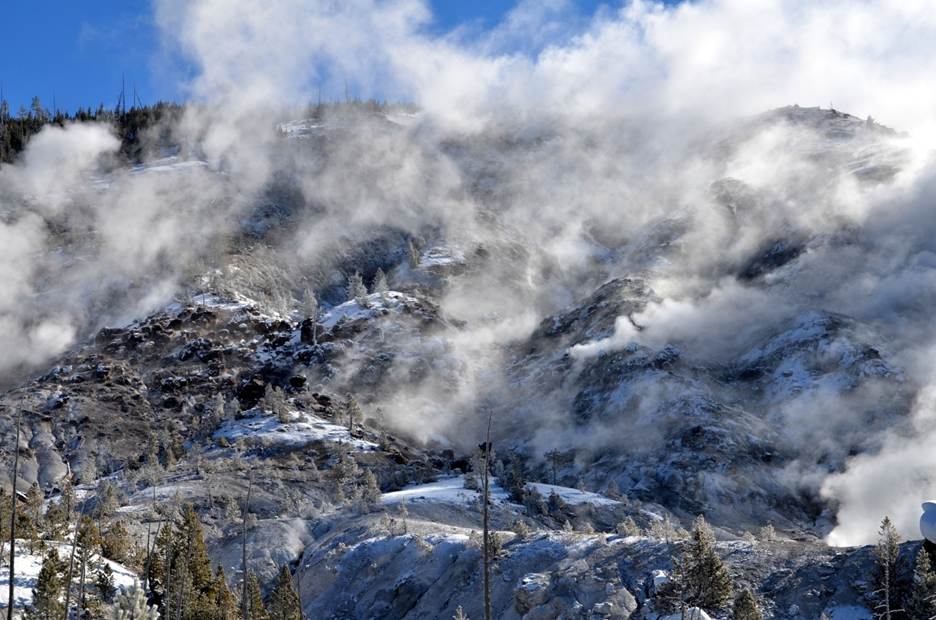
    • Roaring Mountain is one of my favorite thermal features in the park. It has numerous steam vents that make a roaring sound.  It is much quieter today, but there are reports that, at one time, the roaring of the mountain could be heard 4 miles away.
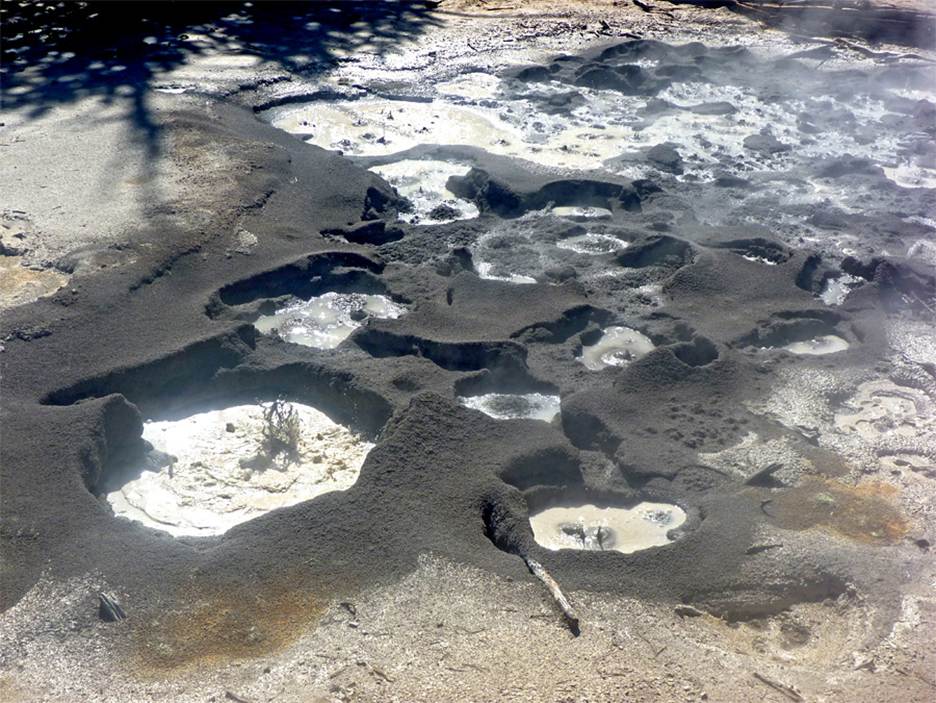
    • Mud pots are unique.  They are not picturesque as other thermal features, but they can be highly entertaining. 
    • Mud pots are acidic enough to dissolve the surrounding rock.
    • They have a limited water supply.
    • Some microorganisms use hydrogen sulfide, which rises from deep within the earth, as an energy source.  They help convert the gas to sulfuric acid and give the mud pots their distinctive odor of rotten eggs.  The sulfuric acid breaks down rock into clay minerals.  Various gases escape through the wet clay mud, causing it to bubble. 

    Yellowstone’s thermal features are beautiful, mysterious, and intriguing.  They are also extremely dangerous.  There are numerous boardwalks built, so that visitors can view them safely.  But, some folks just can’t abide by the rules, and there have been many terrible things that have happened over the years. 

    Several years ago, a dog got loose from its owner and jumped in a hot spring.  Unfortunately, the owner went in after the dog, and both perished.  Dogs are not allowed on boardwalks, trails or in the backcountry. 

    Earlier this season, we had a young man come into the clinic who drank water from one of the thermal features.  Why?  I have no idea.  And exactly what are we supposed to do?

    People are not the only ones who have met their demise in a thermal feature.  Earlier in the season a bison wandered into Grand Prismatic Spring, was trapped and perished.  It was a traumatic thing for tourists and employees to watch. 

    If you choose to visit.  Choose to follow the rules.  When people go off trail in a thermal area, not only are they putting themselves in danger, but they are also permanently damaging the area.  People have thrown coins in Morning Glory Pool that have clogged the hot spring, lowered the temperature and permanently diminishing the colors of this beautiful spring.

    I’m not sure why some people can’t just enjoy nature, snap a photo, commit the scene to memory and move on.  I don’t understand what has happened to this world where the rules just don’t apply to some.  It’s sad, and it’s frustrating.   

    The above information is partly from resources I have including books and the internet.  However, a great deal of the information comes from a friend (and former guide in Yellowstone), Joshua Welter.  I thank him for freely allowing me to use the information he provided. 

    Most photos are stock photos from the internet except where indicated.  All photos from Mammoth Hot Springs were taken by me. 

  • Ursus Arctos Horribilis

    Ursu Arctos Horribilis

    Grizzly Bear

     The grizzly bear is also known as the North American brown bear or simply grizzly.  It is a subspecies of brown bear that inhabits North America.  The name was first given to these bears by Meriwether Lewis and William Clark.  They described it as grisley, which could be interpreted as “grizzly” (as in grizzled with silver-tipped hair) or “grisly” (meaning gruesome).  They were formally classified in 1815 as Ursus horribiis by naturalist George Ord for its character.  I think it has one of the most unique scientific classifications on the planet.  URSUS ARCTOS HORRIBILIS!!! Cue dramatic music. 

    Size

    Grizzly bears are some of the largest subspecies of brown bears.  The only bears larger are the Kamchatka brown bears and the Kodiak bears in Alaska.  Bears inhabiting the coastal areas tend to be much larger than inland bears.  Coastal grizzlies on the Alaskan peninsula can weigh close to 1000 pounds, while inland grizzlies are much smaller and closer in weight to the American Black Bear. Bears in the Greater Yellowstone Ecosystem can weigh between 300-700 pounds.   Interestingly, newborn grizzly bears weigh only 18 ounces.  I find it fascinating they can grow to be such large and majestic predators. 

    Characteristics

    Grizzly bears can vary in color from blonde to almost jet black, but they are typically brown with darker fur on their legs.  As they age, grizzlies can get blonde or white tipped fur on their flank and back giving them that silver-tipped appearance.  

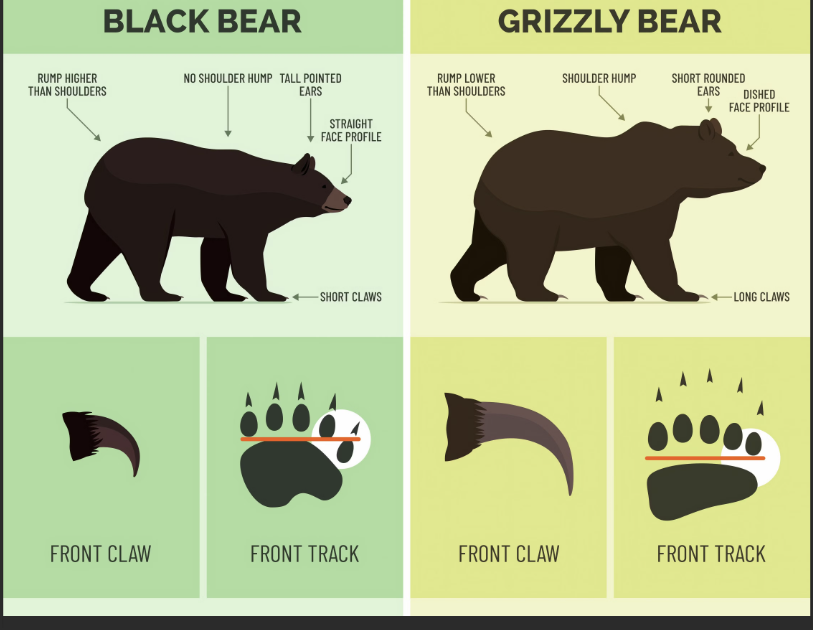
    There are very definite differences between black bears and grizzly bears. It’s super important, if you choose to hike in the backcountry, to know the differences. The two different species behave differently when they encounter humans. And, likewise, humans need to behave differently when encountering bears.

    The following chart shows the basic differences between the black bear and the grizzly bear.

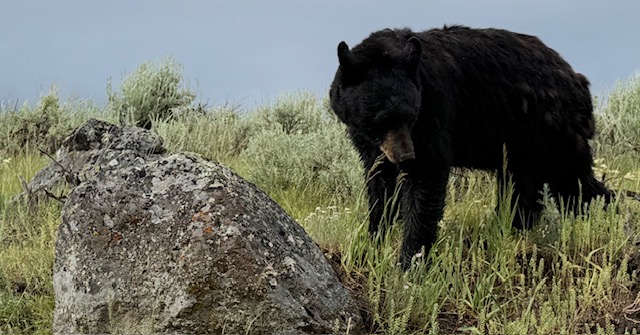
    There was a black bear in the northern range of Yellowstone National Park early this spring and summer that people really struggled to identify.  There were a lot of posts of Facebook asking, “Is this a black bear or a grizzly bear?!?” I have observed lots of black and grizzly bears over the years, and this one definitely challenged me.  (No, I am not claiming to be a bear expert. But I am well-schooled thanks to years of observation and lots of studying.) He was large and had an interesting rust colored, long and shaggy coat.  The coat gave the appearance of a hump on his shoulders fooling a lot of people. The key to identifying him was to look at his face and ears.  He had a straight face profile and NOT a dished face. 

    Range

    In North America, grizzlies previously ranged from Alaska to Mexico.  They were present as far east as Hudson Bay.  They are currently found in Alaska, Western Canada, Washington, Idaho, Montana and Wyoming.  There have been rumors of grizzlies or grizzly hybrids being present in Colorado.  I have word of mouth from my brother-in-law about the hybrid.  He lives in the National Forest during the summer months, and I’m not going to argue.  This is not scientifically verified, but interesting, nonetheless.  (Remember marijuana is legal in Colorado, and mushrooms grow wild. Just saying…)

    There are approximately 15,000 bears in Canada.  As of 2022, there were an estimated 962 grizzlies in the Greater Yellowstone Ecosystem. As of this writing, there is research and counting and tagging operations on-going in Yellowstone National Park.   

    PERSONAL ENCOUNTERS

    The first grizzly I saw was in Yellowstone National Park with my husband at the time, and still a very dear friend, Tony.  We visited Yellowstone for the first time in the 1990s.  I am not good with dates, but Evenflow by Pearl Jam was popular.  So, I am thinking it was in the early to mid-1990s. (Tony will reply to this blog and correct my dates!)

    We were driving up Dunraven Pass in Yellowstone and came around the curve at Chittenden Road.  There was a TON of cars pulled over, and we knew it was a bear jam.  (You can usually tell what animal is being observed by the number of cars pulled over and whether people are acting insanely.)  We jumped out of the truck (Tony forgot to set the brake) and hustled over to watch the most beautiful, young brown grizzly grazing in purple flowers.  We were scolded for running and getting too close by a woman who became a lifelong friend.  She is a local photographer and sent us a gorgeous photo of this grizzly. Tony still has the photo on his desk. 

    I am convinced that bear was the legendary bear who went on to be known as Scarface.  He lived a long and legendary life but was ultimately killed illegally.  A damn shame for such a majestic creature.  The last time I saw and photographed him was in that very same area.  The next year, he was dead. 

    Another bear we observed for several years was #264.  (I should explain that bears are captured, tagged and often collared for research purposes. This is how she got the number 264.) She was a beautiful bear and a great mom.  We got to see her give her cubs their first swimming lesson on the west side of the park one year.  One of my two prized photographs I’ve taken in Yellowstone is of 264, and I have it hanging in our dining room.  She brought so much joy to so many.  264 was, unfortunately, struck by a truck and killed on the road one season.  Tributes went up all around the park and gateway communities.  She was fantastic.

    I have had so many wonderful grizzly bear sightings over the years.  I’d like to briefly touch base on one, but she deserves an entire post of her own.   Grizzly 399, The Queen of the Tetons.  She was the most famous bear in the world.  When she passed away, I sobbed like I had lost my best friend.  As I write this, I am fighting back tears.  She was everything to the bear world in Grand Teton National Park.  And everything to Thomas Mangelsen. He is one of the most amazing wildlife and nature photographers of our time and followed 399 for all of her 28 years.  It’s so difficult not to anthropomorphize these animals.  We all did that with 399, and her loss was devasting.

     The grizzly represents a great recovery effort. It is still listed as “threatened” under the endangered species act.  There are constant political battles to remove it from that list to open hunting seasons on grizzlies.  There is already a hunting season for black bears. Perhaps in a later post I will address my views on this subject. 

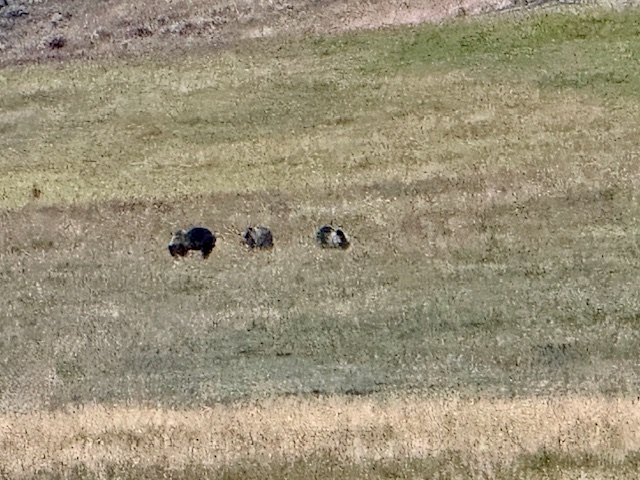
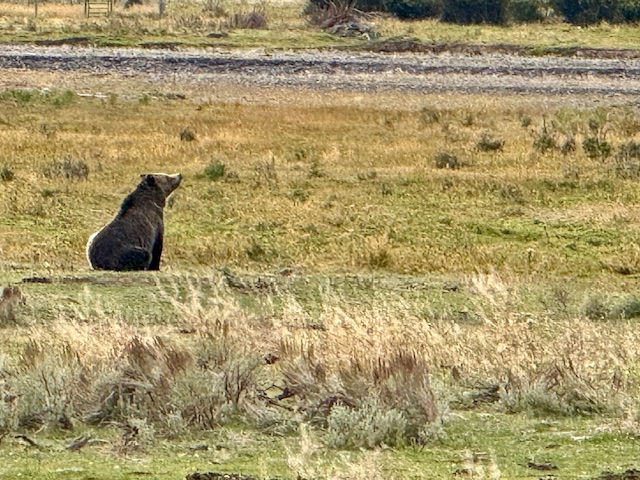
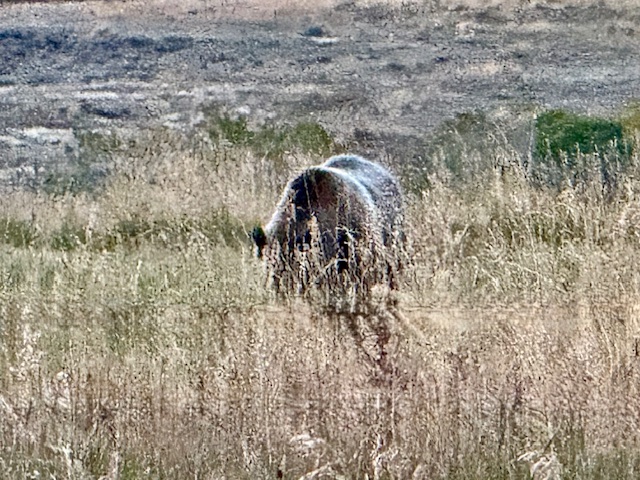
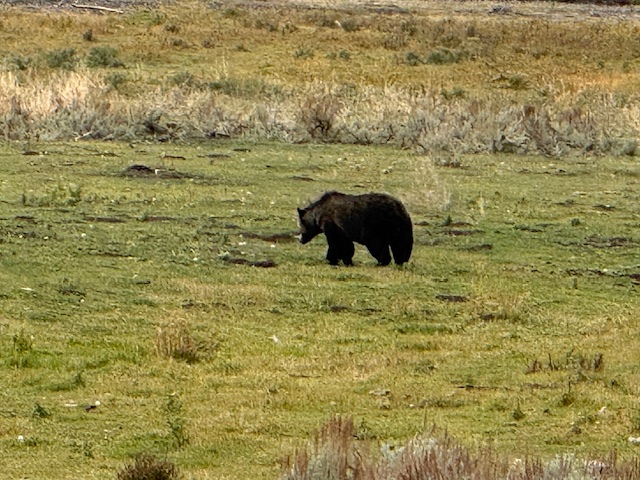
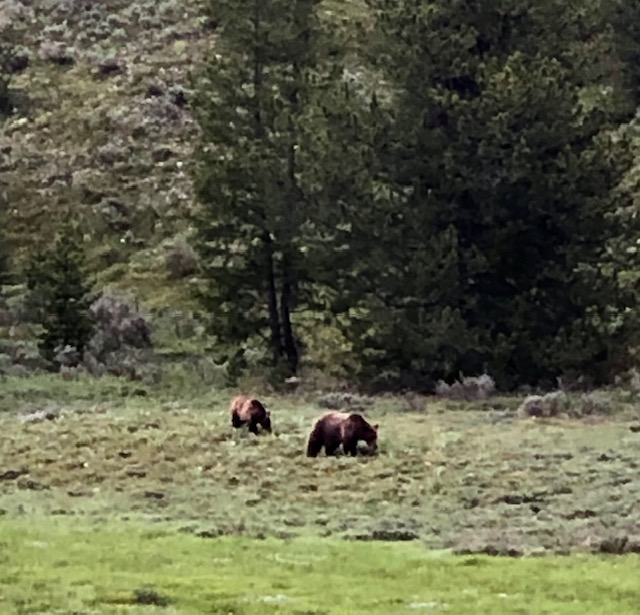
    Below are some of the photographs I have taken of grizzlies in the last two years.

  • A Day in the Life….

    Settle in with a cup of coffee or a glass of wine – it’s a long one.

    People have asked me what it’s like to be a nurse in Yellowstone.  A lot of descriptors come to mind – exciting, different, enjoyable, challenging.  But I think the best word I can come up with is unpredictable.  Each day is different.  You never know who will walk through the door at any given moment.  That includes a couple of my local heroes. I have learned I get very tongue-tied when I am around people I admire. So, if I speak incoherently when we are together – just know I admire you and am, most likely, not drunk.  (Leana, you are exempt from that statement, as it could be either or both.)

    There are three clinics in Yellowstone National Park. They are located at Lake Village, Old Faithful, and Mammoth Hot Springs.  The clinic at Mammoth is open year-round and has full-time staff. Each clinic has different hours to accommodate the needs of visitors.  Lake and Old Faithful are in the interior of the park and are much more remote than Mammoth.  Housing there is definitely NOT the bougie apartment my roommate and I share…. which I am grateful for every day and have some associated guilt. Good Baptist girl, here. 

    The clinic in Mammoth is different in that we have a full-time physician on site.  We function a bit more like a family practice clinic than the other clinics and see many of the folks in the surrounding communities for primary care.   It is important to note that visitors don’t always understand what purpose we serve.  We are not an urgent care facility.  Nor are we a first aid station.  We are not a pharmacy or a medical supply store.  If you are a park employee – particularly Ranger Joe and EMS staff – we ARE a free ice cream parlor.  Joe has been a ranger in the park for 800 years.  He has some sort of special ice cream radar for when the truck delivers to the clinic.  He shows up about two minutes after the truck leaves.  There is always a supply of Wilcoxon’s ice cream bars and goodies. They make incredible huckleberry fudge ice cream.  There are really no words…but I digress.  If someone comes into the clinic with an issue, they must make an appointment and be seen by the provider.  Due to liability issues, we can’t render care without the patient having an appointment.  We are staffed by MDs, PAs, NPs, RNs and our own Disney Princess Cruise Director, Barb, who drives the ship in Mammoth.  She is gorgeous with long flowing blonde hair.  The first time I met her and saw someone with hair and makeup in check, I thought “Ooooh!!  My people!!!”.

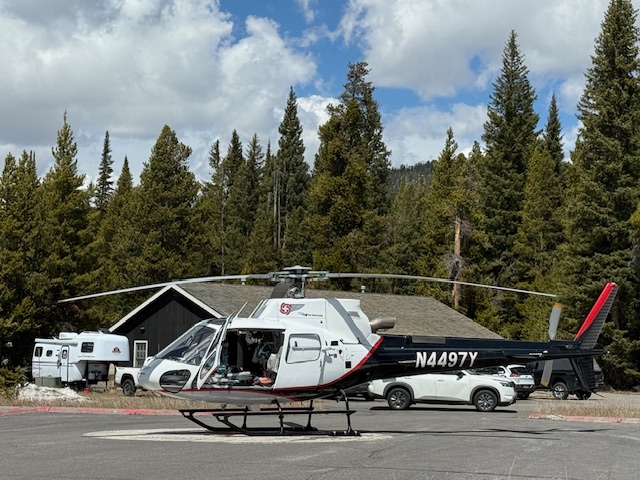
    What kinds of ailments do we treat? Well, this year I have cared for a patient having an inferior wall MI (giant, life threatening heart attack), broken bones, lacerations, scrapes, abdominal pain, headaches, splinters, nausea/vomiting, adverse reactions to first time as well as chronic use of marijuana (legal in Montana), sexually transmitted diseases, COVID, influenza, shortness of breath, altitude sickness, scabies (I’m sorry, what? I thought only pirates get scabies – then I remembered that is scurvy.  My mistake.), burns from tourists who can’t, or won’t read, and feel the need to put an appendage in a thermal feature, and my all-time favorite (so far) a dude who drank water from a thermal pool/hot springs.  My friend, Tony, told me he didn’t think I would be very good at this job.  He knows me and knows I just want to shout, ‘What the hell is wrong with you?!?!?!”  I haven’t.  Yet.   We are across from the Justice Center and near the jail, so we do get an occasional prisoner.  That just reminds me of my days at Parkland in Dallas. Most patients are treated in the clinic and discharged.  However, there are some who require a higher level of care than we can provide. Depending upon the gravity of their situation, they are either transported via ground or air.  We have a helipad near the clinic.  When I hear transport coming, I feel like yelling, “Choppers!!!!!”, like Radar on MASH.

    The closest hospital to Mammoth is over an hour away in the town of Livingston.  That is the closest hospital to any of our clinics.  The closest hospitals to Old Faithful and Lake are over an hour and a half away, and they are not trauma hospitals.  We do what we can to stabilize patients and then ship them out as quickly as possible if that is necessary. We do not normally get emergencies from the field – meaning severe injuries from car or motorcycle accidents or hiking/climbing accidents.  They are usually transported by EMS to a facility with a higher level of care. 

    My typical day at work begins with a 4-mile commute and gains about 1500 feet.  It’s officially called the Old Gardiner Road, but my roommate, Paula, calls it Mario Kart Road.  It has 67 turns in 4 miles – I counted.  For reference – the Road to Hana has 600 curves in 64 miles. So, technically, it has more curves per mile than the Road to Hana.  It is a beautiful drive to work.  I have views of Electric Peak. Sepulcher Mountain, Bunsen Peak and Mount Everts.  It’s fun to go through the “Employee” entrance at the gate.  I get waved on through, because I have a sticker on my window saying I am a park employee.  I am special – been telling Suzi that for decades.  It makes me feel so important.  LOL. 

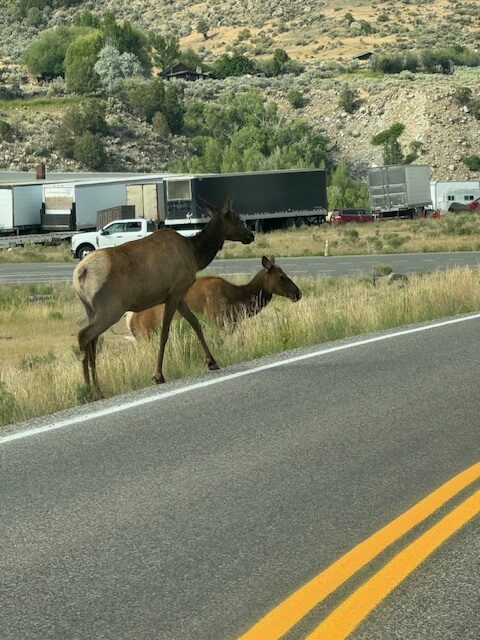
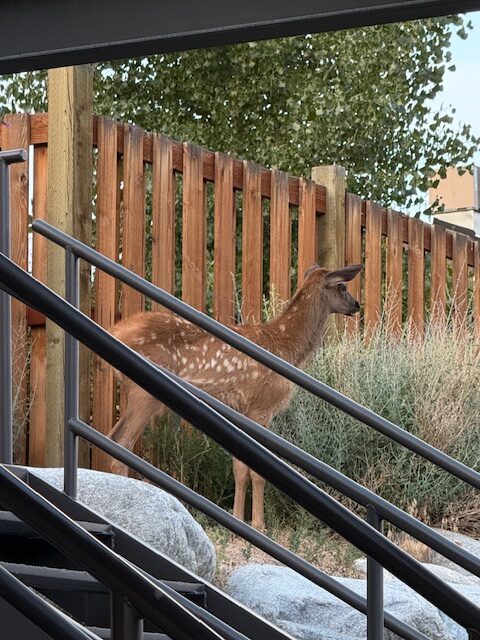
    I have encountered a lot of wildlife on the drive to work including elk, pronghorn, bison, ducks, coyotes, birds of prey, and a badger.  It’s always an adventure!  The “traffic” through the town of Gardiner has nothing to do with cars or people and everything to do with the local elk.  Elk have their babies in late spring/early summer, and they are all over town.  We must be very careful when walking around town, because mama elk are very protective.  One morning, I got a text from Paula asking if I knew baby elk like to eat flowers.  It took me a second to understand that was her very gentle way of telling me they ate all my potted plants on the porch.  Mind you – we live up about 6 steep stairs in a gated area!!!  There is no Starbucks in Gardiner, so I frequent the local place called Bears Brew. My favorite is an iced oat milk Yellowstone River Latte – it has hazelnut and caramel. Yum!!!  (There is also a cute barista boy with a man bun and very intense eyes who makes eye contact with you the entire time you are ordering.  I suppose he is the sensitive, mountain man type. He’s a cutie but can never remember I don’t want cow’s milk. I forgive him. Daily.)

    Working in Yellowstone as a nurse has given me skills, I never thought I would learn or even need to learn!  My job description includes front desk secretary duties responsible for billing and coding, checking insurance eligibility, completing paperwork, answering phones, collecting payment, making appointments and calming freaked out parents whose little one has a teensy tiny splinter; staff nurse duties responsible for triage of patients, vital signs, wound care, medication administration, etc.; x-ray tech; phlebotomist; lab technician processing labs in the centrifuge (huh?); Amazon package sorter; and mail runner.  Interestingly, our interoffice mail consists of suitcases that are packed with whatever clinics need.  That can be anything from toilet paper to medication. There is a courier who picks them up and transports them to the other clinics in the park. We are responsible for calling the communications center for transport of patients who need a higher level of care.  And – general greeter of visitors, guardian of wildlife, and snake charmer.  (We had a four-foot bull snake who came to our yard to eat the prairie dogs who live around the clinic. I was not amused….at all. Paula was beside herself.  She loved those little prairie dogs.) I have gained a lot of experience with drawing blood and starting IVs – for which I am grateful.  I needed it.

    Yesterday, we had elk all over our lawn which brought tourists who approached way too close.  They are supposed to stay 25 yards away.  They were about five yards away and inching closer.  So glad Mr. Ranger came to save the day.  I was about to go all crazy on them.  I’ve thought of flashing my nursing badge at them and saying, “Law enforcement! Move along!!”  But that might be a federal offense.  We have a giant sign guiding people to the back door if the front door is blocked by animals.  There have been black bears in the village for the last two weeks.  One ran through the parking lot last week and we got a great view of him/her.  There was a grizzly sow and two cubs in the village a few weeks ago.  The NPS does a good job of hazing them out of the area to keep the bears and visitors safe. 

    The day ends for me around 5:00.  Only once this season (during my shift) has someone walked in the door at 4:58. Bastard. I head back down the hill to Gardiner and still have many hours of daylight left for exploration.  It’s a great gig.  I will forever be grateful for this experience. 

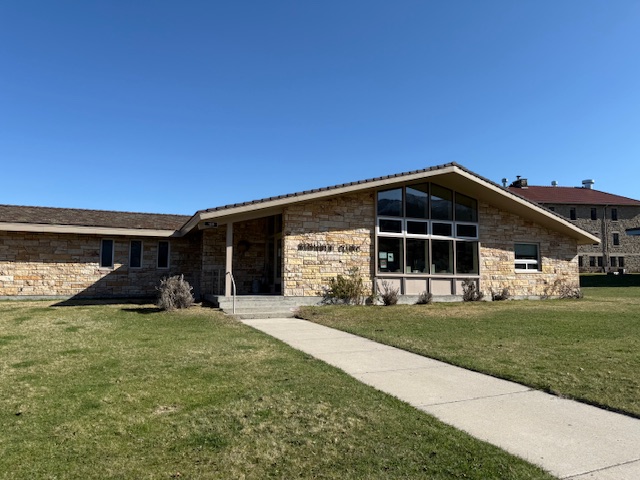
    The Mammoth Clinic – mid-century modern Brady Bunch house.
    CHOPPERS!!!!!!!!
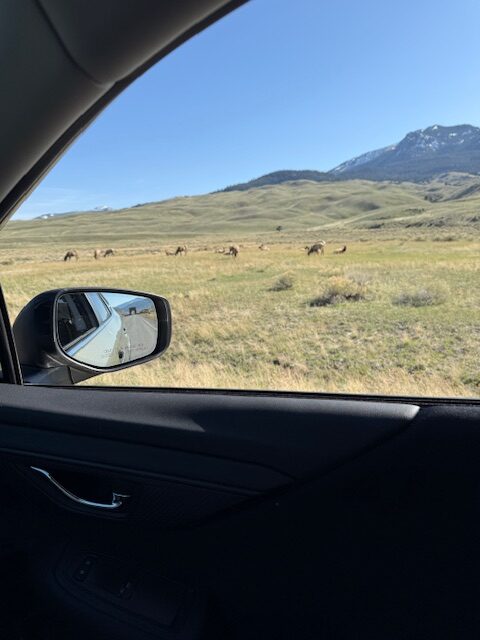
    Elk on the Mario Kart Road – Roosevelt Arch in my rearview mirror
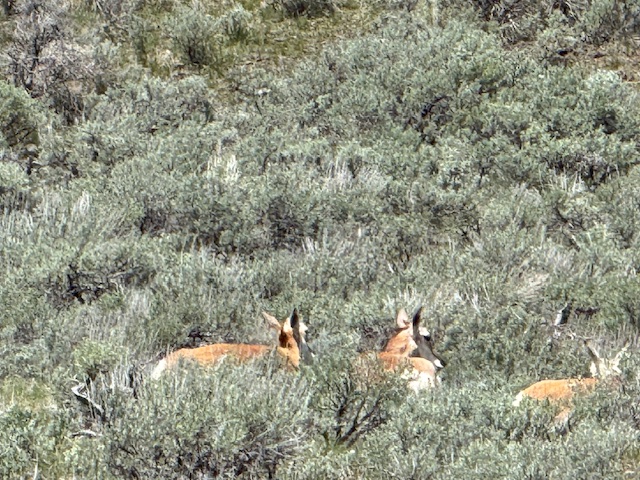
    Pronghorn
    Morning Commute
    Very possibly the sweet, little angel baby that ate my petunias.
  • Bison bison

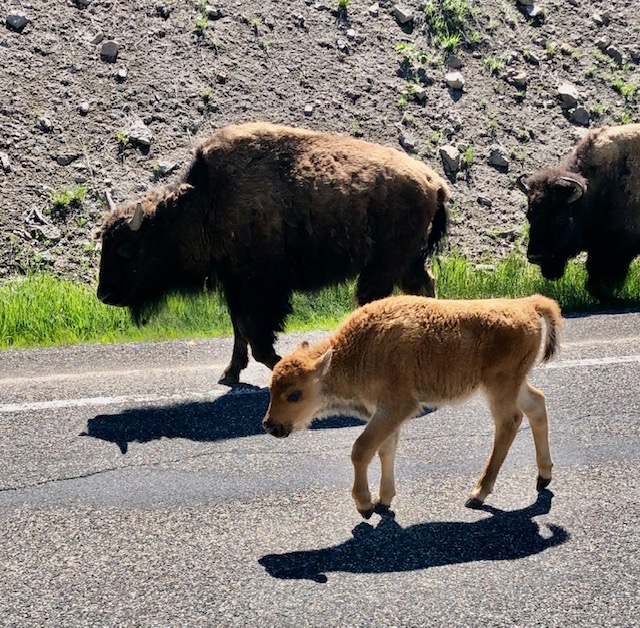
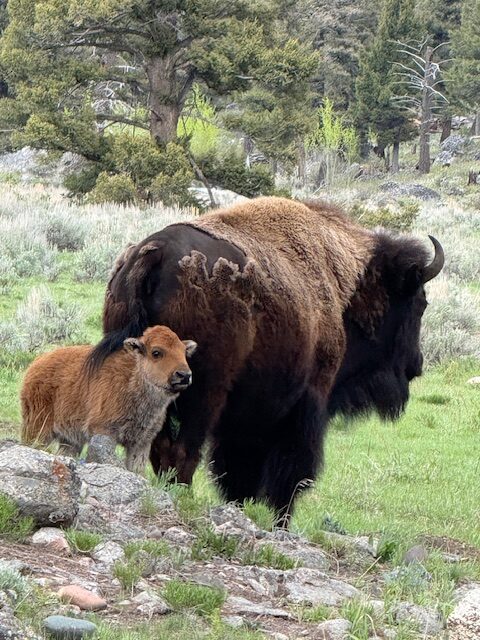
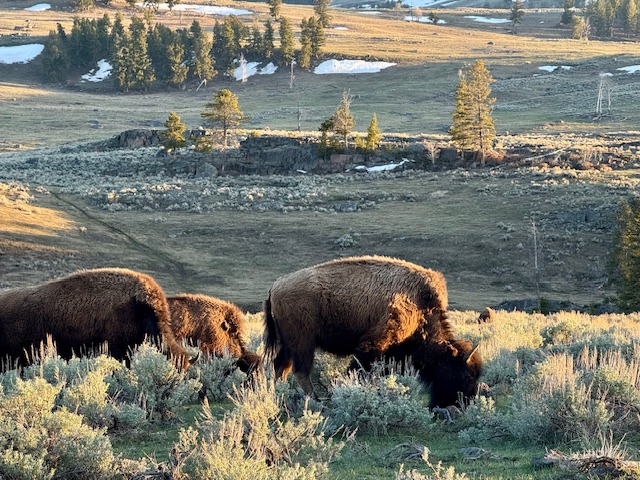
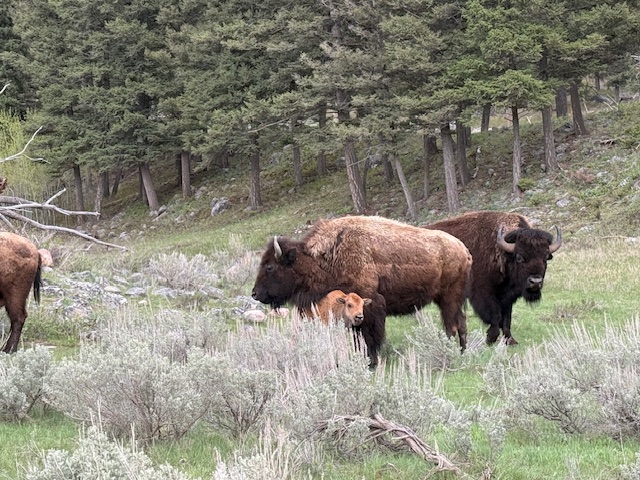
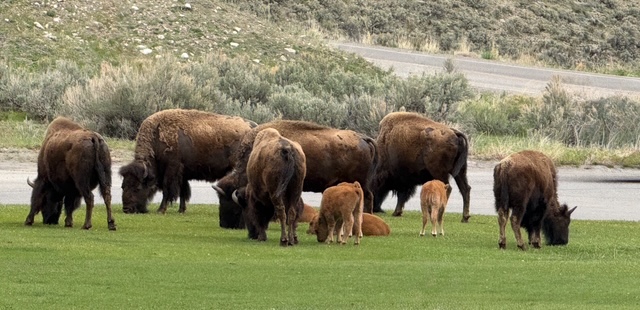
    The American Bison (Bison bison), also known as the American buffalo, is endemic to North America.  Evidence suggests they were roaming the land in 9000 BC.  Historically, they lived in the Great Bison Belt which spanned from Alaska to the Gulf of Mexico. There are two subspecies of bison: the plains bison and its larger cousin the wood bison.

    Bison once roamed in large herds with an estimated population of around 65 million in the late 18th century.  Due to commercial hunting, slaughter and the introduction of bovine diseases, the species became nearly extinct in the 19th century.  By 1889, the population was down to just 541 animals.  By 1902, poachers had reduced the population in Yellowstone National Park to 25 animals.

    Yellowstone is the only place in the United States where bison have lived continuously since prehistoric times.  Conservation efforts began in 1901. Congress appropriated $15,000 to augment the herd.  21 bison were purchased from private owners.  They were fed and bred at Lamar Buffalo Ranch in the Lamar Valley in Yellowstone.  They were eventually released into the park to interact and breed with the free-roaming population.  In 2024, the population was estimated at 5,400. This is a huge conservation success!!

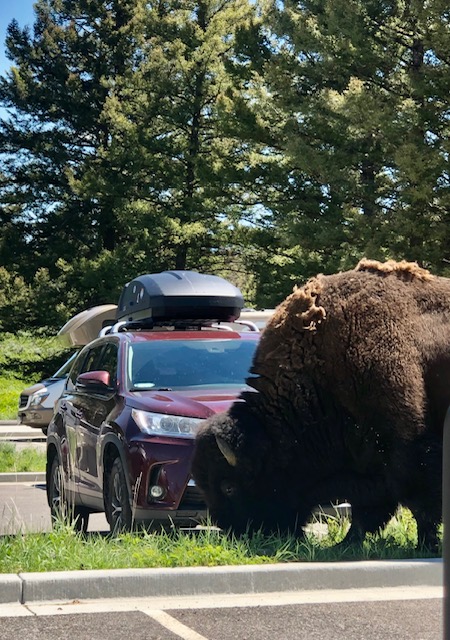
    Males (bulls) can weigh in at 2,000 pounds, while females (cows) weigh in at around 1,000 pounds. They usually live 12-15 years but can live up to 20 years. They graze on grasses and sedges.  They can be seen in the grassland areas of the park in summer such as Hayden Valley and Lamar Valley.  They migrate to warmer, thermal areas in winter which include Mammoth Hot Springs, Norris Geyser Basin and Old Faithful. Mating occurs in late July through August, and calves are born in late April to May.  They may appear to be docile and slow, but do not be fooled.  They are extremely agile and can be easily irritated.  They can run up to 30 miles per hour.  Every year in Yellowstone there are human/bison encounters.  People have been attacked, gored and even killed by bison.  They are not fluffy Highland Cows, so don’t pet them. 

    (All information comes from NPS handouts and websites.)

  • Feeding Frenzy and Food Sources

    Not all seasons are created equal

    I learned some interesting information about the food sources for bears this season from Kerry Gunther.  He is the bear management biologist in Yellowstone. 

    Grizzlies and Black Bears typically feed on White Bark pinecones this time of year.  They are rich in nutrients and are a prime food source. However, they have been in decline in abundance over the past several years.  There are several reasons for this decline including a fungal disease called white pine blister rust, an increase in the prevalence of mountain pine beetles, and alterations to natural fire regimes. All of these are exacerbated by climate change and global warming.  (Yes, it is a real thing!)  There is a proposal to have the white bark pine listed for protection under the US Endangered Species Act.

     The white bark pine trees did not produce a lot of cones this year.  The bears should be up high on the slopes feasting on the cones.  However, they are down lower looking for other food sources.  They are feeding on chokecherries and Limber Pine pinecones, both of which are having bumper crops.  It is reported that rosehips will also have a bumper crop this year.  Mammoth Hot Springs (where I work) currently has about a dozen bears in the area and some have cubs.  Thus far, they are focused on feeding and are in hyperphagia.  Hyperphagia occurs in the fall and is an intense, constant feeding phrenzy that helps the bears gain a fat reserve to sustain them through hibernation in winter.  Luckily, they have not been getting into anything they shouldn’t.  They have figured out there are chokecherries on top of some of the cabins and have been climbing up there to feed.

    Years ago, chokecherries and Limber Pine were planted in the Mammoth area for ornamental purposes.  They were cut down about 30 years ago when 3 kids and 2 bears were found in the same tree!!!!  They have since grown back, and the park service is coming up with a plan to eliminate them again. 

    Here’s hoping the bears and humans can stay in their respective lanes over the next couple of months. 

  • Ursus Americanus

    The American Black Bear

    The black bear is endemic to North America.  It has a wide range and can be found in almost all contiguous 48 states.  Only the central U.S. states of North Dakota, South Dakota, Nebraska and Kansas are reported to not have populations. 

    The black bear is significantly smaller than the grizzly bear. Their size and weight vary depending upon age, sex, health, season and habitat.  Bears on the east coast are heavier than bears on the west coast, and bears in the northwest are larger than bears in the southeast.  Their weight can range from around 125-550 pounds for a male, while females weigh 90-375 pounds. 

    Black bears are not just black.  Their coat covers the color spectrum. They can be white, blonde, cinnamon, light or dark brown, and jet black.  Only 50% of the black bears in the Rocky Mountains are black.  I saw a gorgeous black bear this spring that was cinnamon in color.  White- and cream-colored black bears are found in the coastal areas of British Columbia and are known as Spirit Bears.  They are a subspecies of the American Black Bear.

    Black bears prefer areas that are mountainous and heavily vegetated.  They are EXCELLENT climbers!!  I have made the rookie mistake of only looking on the ground for black bears – then to look up and see two cubs asleep in a tree while mom was out feeding.  They are omnivorous and consume plants, fruit and berries, insects, small mammals and carrion.  Autumn in the Rockies is berry season.  I have spent MANY hours observing black bears on the Moose-Wilson Road in Grand Teton National Park feasting on Hawthorne Berries.   

    They are typically solitary and do not seek out interactions with humans.  However, as I have said before, there is a saying “A fed bear is a dead bear”. This applies to ALL species of bears. They are somewhat opportunistic and will go where they have found food before.  So, cleanliness is terribly important in any wilderness area.  When bears become too comfortable around people, they gain the label of “habituated”.  This is often a death sentence.  There was a black bear I observed on many occasions in the northern range around the Blacktail Deer Creek drainage of Yellowstone this spring. That bear was eventually euthanized on July 11th.   She reportedly crushed an unoccupied tent and climbed a food storage pole to consume human food.  This posed a clear threat to humans, and the decision (albeit a very difficult one) was made to remove her from the ecosystem.  The campers over the season had done nothing wrong.  The bear saw an opportunity, took it, and it cost her her life. 

    They breed in the summer from June through August.  Like, grizzly bears, they have delayed implantation of the fertilized egg.  It is suspended until the fall.  It then attaches to the uterus and pregnancy begins.  Why?  This allows the female to boost her body fat before she enters the den.  This serves her babies well over the winter. The cubs are born in late winter and weigh in at only 8-12 ounces!!!  The are born without teeth, are blind, and only have a small amount of very fine hair covering them. 

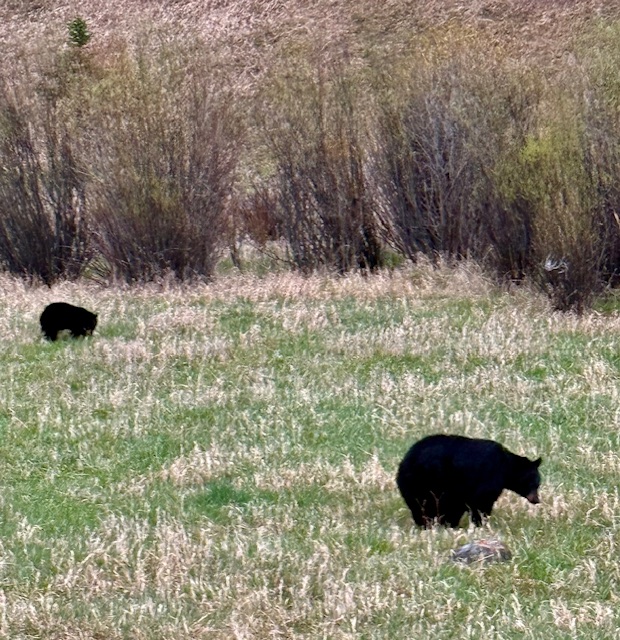
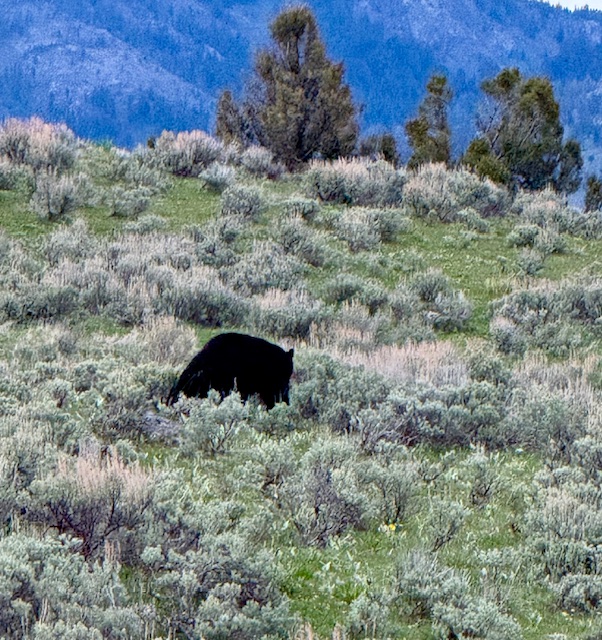
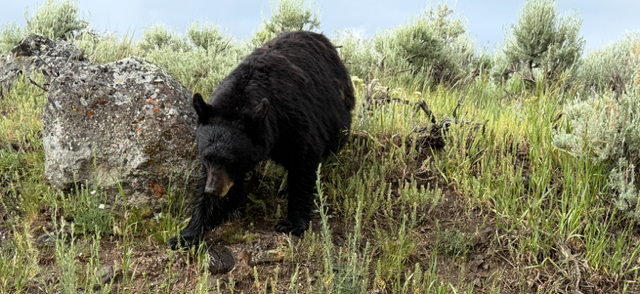
    Newborn cubs are called cubs of the year or COYS.  One year old cubs are called yearlings.  They typically stay with mom until they are two, at which point she’ll kick them off so she can breed again. Spring and early summer in Yellowstone are magical!  I have included some of the moments I had with black bears this season!  Enjoy!

    Please feel free to ask questions in the comment section.  While I am not an expert – I am blessed to know PLENTY who are in the area!!!

  • Summer fades to Autumn

    August 24, 2025

    This has always been my favorite time of year.  Living in Texas all my life has not really afforded the opportunity to see the seasons change on the timeline Mother Nature intended. We often don’t have leaves changing until November.  Then the first blast of cold air comes in from Canada, the wind blows, and POOF!!  Autumn has ended overnight.  And, for some reason, that always made me a little melancholy. 

    Yellowstone is different.  The ebb and flow of the changing season is palatable.  Rather than fresh flowers at the local market, there are now bundles of firewood.  You can see people preparing for the long winter that is inevitably just around the corner.  Fruit – cherries, pears, peaches and apples – are ripening on the trees.  Communities are coming together to harvest that fruit as quickly as possible.  Chalk this up to things you don’t have to worry about in North Central Texas – ripening fruit is an attractant.  For grizzly bears.  The community in which I live – Gardiner – has had problems with bears coming into town in the past.  So, the locals are doing what they can to stay safe and keep the bears safe.  There is a saying in the park – “A fed bear is a dead bear.”  Bears become habituated quickly if they are fed – either intentionally or unintentionally. 

    I took a drive on one of my favorite little “back roads” in Yellowstone earlier in the week.  It’s called Blacktail Plateau Drive. It is a six-mile road that (mostly) parallels the main road.  But it is an oasis. I have driven it many times over the past 33 years, and I have always been rewarded with beauty.  I have seen a wolf, two blonde grizzlies, a coyote, and some of the most beautiful scenery.  There are a lot of aspen trees tucked back there, and some are already starting to display their gold finery for the season to come. 

    The animals are responding to the changing seasons as well.  The prairie dogs are already hibernating.  The bison are in a full rut!  It is mating season, and love is in the air.  The elk are starting to come into their mating season as well.  More are filtering into Upper Mammoth, and soon they will be all over the lawns of the folks who live in Upper and Lower Mammoth Village.  They will be on the lawn of the clinic where I work, and we will have a big sign out reminding people not to come too close.  Apparently, there is a big, glorious – although quite temperamental – bull elk (#24) who loves to have a go at it with cars.  He can be quite testy during this mating season as he rushes to secure a harem to carry on his legacy. 

    I love autumn.  I love pumpkin spice everything, and I cannot wait until our local coffee house, Bears Brew, has that as a choice on the menu.

    Take time to watch how nature changes as the seasons flow from one to the next. 

  • Welcome to th blog about my experiences in Yellowstone!

    My name is Brenda Armstrong. I have been a registered nurse for 34 years. 33 years ago, when I first came to Yellowstone National Park, I walked into the clinic at Mammoth Hot Springs and asked how to get a job there. With very little nursing experience, I was patted on the head and told to check back.

    I was never in a position to pursue the dream of living and working in Yellowstone. In actuality, I think I forgot about the dream for a very long time. I worked at hospitals and clinics in Dallas, Plano and Denton, Texas, and gained a lot of knowledge. Some that would eventually prepare me for this position, and some that prepared me for life in general.

    Last September, I found myself disillusioned with work. I felt sort of stuck, even though I had a great job and worked with a lot of great people. I went home one evening and had a long talk with my wife, Suzi. I told her how I felt, and I told her how unhappy I was. She listened. She worried. She crunched the financial numbers. And, most of all, she supported me. Together we decided it was possible for me to make a change.

    I had no idea what I wanted to do. I didn’t know if it would be in a hospital setting, a clinic setting, or even in the medical field at all. I worked for a brief time at the Zoom Room in McKinney and worked my way from front desk staff to dog trainer. I absolutely LOVED working there. But I needed to bring home just a bit more cash. So, one autumn night, after a glass (maybe two) of my favorite Sauvignon Blanc, I thought “hmmmmm I wonder if there are any nursing jobs in Yellowstone?!?!?” So, without disclosing what I was doing to my sweet wife, I googled “nursing jobs in Yellowstone National Park”. Much to my surprise I hit the motherload. Somehow, I was guided at the moment to search just as the jobs were being posted. I applied and still didn’t tell Suzi. I never thought anything would come of it. Well, then I got an email inviting me to chat with HR. I did. I was told I didn’t have the qualifications they were looking for. Meaning – I didn’t work in either ER or ICU at that time. So, I let it go and prepared to move on. I told Suzi about it and let her know I was not qualified. I got a job working in a PACU in McKinney. Made some amazing friends and learned SO much – including my weaknesses as a nurse.

    Not long after I started working there, I got an email that informed me I was a candidate for the Yellowstone position. Three interviews later, I had somehow managed to land my dream job. When things started to get serious, Suzi and I found ourselves facing the reality that we might be living apart for up to six months.

    My wife is a saint, and I cannot believe she chose to spend her life with me. I am so blessed. We talked and talked and talked about the transition. I kept asking for her permission. She told me I never have to ask for permission, because I am an adult and my own person. She said she felt as if she had to be fully supportive, because it was my dream. I will be forever grateful to her for being my rock and giving me her full support.

    This blog was supposed to be up all summer, but I am severely technologically challenged and just figured that darn thing out. I will post as often as I can. Welcome to my blog.